
The blog
Can Personalized Products Be Returned? Yes | 2026


Personalized products can be returned in 2026, but they do not automatically qualify for the same returns as regular items. A damaged, defective, or incorrectly personalized order normally supports a remedy; a correctly made item that matches the buyer’s approved choices is governed by the seller’s stated policy. Cancellation rights, return rights, remakes, and refunds are separate decisions.
TL;DR
- Can personalized products be returned? Yes, when they are defective, damaged, or different from the approved order.
- A correctly made personalized item is not automatically returnable because the buyer changed their mind.
- Customer input, proof approval, production status, store policy, and local law determine the outcome in 2026.
- Bespo helps Shopify merchants capture personalization choices and create production-ready files, but merchants still set their return policies.
Why this matters
Regular inventory can often be inspected, restocked, and sold again. A product carrying someone’s name, photograph, initials, measurements, or message has a far smaller resale path, so merchants usually apply a separate policy.
That policy must still distinguish buyer preference from seller error. Treating every request as non-returnable creates disputes when the product is damaged or differs from the submitted design. Treating every request like a regular return leaves the merchant absorbing avoidable remakes.
For Shopify merchants, the practical fix is a documented personalized order refund and return process that connects the product page, checkout record, approved design, production file, and support response.
Can personalized products be returned like regular items?
No. Personalized products can be returned, but the reason for the request matters more than a standard return window. The merchant first checks whether the item matches the customer’s submitted and approved instructions.
Item matches the approved personalization
- Usually treated as: Buyer preference
- Practical resolution: Apply the stated personalized-item policy
Seller used the wrong name, image, color, or placement
- Usually treated as: Seller error
- Practical resolution: Correct, remake, replace, or refund
Item arrived damaged
- Usually treated as: Damage claim
- Practical resolution: Review evidence and provide the stated remedy
Product has a manufacturing defect
- Usually treated as: Defect claim
- Practical resolution: Repair, replace, remake, or refund as required
Buyer entered incorrect information
- Usually treated as: Customer input error
- Practical resolution: Apply the policy shown before purchase
Buyer requests cancellation before production
- Usually treated as: Cancellation request
- Practical resolution: Check whether production has started
The phrase final sale does not answer every row in this table. It usually addresses returns based on preference, not an item that arrived defective or materially different from the order.
In the United States, online shoppers do not have a general federal right to return every purchase within 3 business days. The Federal Trade Commission’s Cooling-Off Rule covers qualifying sales made in certain off-premises settings and excludes transactions completed entirely online. State law, warranties, marketplace terms, and the merchant’s published policy still affect the result.
International orders require a separate review. The European Union’s Consumer Rights Directive provides a 14-day withdrawal period for many distance purchases but contains an exception for goods made to the consumer’s specifications or clearly personalized. The United Kingdom’s Consumer Contracts Regulations 2013 contain a similar personalized-goods exception, while faulty or misdescribed goods remain a different issue.
When can a personalized product be returned?
A return has the strongest basis when the delivered product fails to match the agreed order. The merchant should compare the physical item with the submitted text, uploaded image, selected options, approved preview, and production record.
Common qualifying situations include:
- Wrong personalization applied: The customer entered one name, but a different name was engraved, embroidered, printed, embossed, or debossed.
- Missing personalization: The order included a selected custom element, but the delivered item omitted it.
- Mismatch with the approved proof: The customer approved one layout, while production used another.
- Damage in transit: The item arrived broken, torn, scratched, stained, or otherwise damaged.
- Manufacturing defect: The base product or personalization failed independently of the customer’s submitted choices.
- Incorrect product supplied: The customer received a different item from the one ordered.
A return is not the only remedy. Depending on the policy and applicable law, the seller can correct the item, remake it, replace it, or issue a refund. The response should fit the failure rather than defaulting every case to the same outcome.
Can a correctly personalized item be returned?
A correctly made personalized item can be returned only when the merchant’s policy permits it or applicable law requires a remedy for another reason. There is no universal rule forcing a seller to accept a buyer-remorse return simply because the customer no longer wants an item that matches the submitted design.
This distinction applies when the customer:
- Changes their mind after production.
- Dislikes text they entered and approved.
- Uploads the wrong image.
- Selects the wrong option from a clearly presented menu.
- Orders a gift that the recipient does not want.
- Requests a different design after receiving the approved one.
The merchant’s product page should disclose the restriction before purchase, not reveal it after a request arrives. Clear wording should also explain whether the store offers discretionary corrections, paid remakes, exchanges, or store credit for customer-input errors. Do not promise an option the operation cannot deliver consistently.
Why personalized return decisions vary
Six factors decide whether a personalized return is accepted in 2026:
- Store policy: The terms displayed before purchase define how buyer-remorse requests, customer errors, cancellations, defects, and damage are handled.
- Error source: The merchant compares what the customer submitted with what production made.
- Proof approval: A saved preview or proof shows whether the delivered personalization matches the approved design.
- Production status: A cancellation before work starts is different from a return after engraving, printing, embroidery, or cutting is complete.
- Sales jurisdiction: Consumer rights differ between US states and international markets.
- Marketplace terms: A third-party marketplace can impose processes beyond the merchant’s own storefront policy.
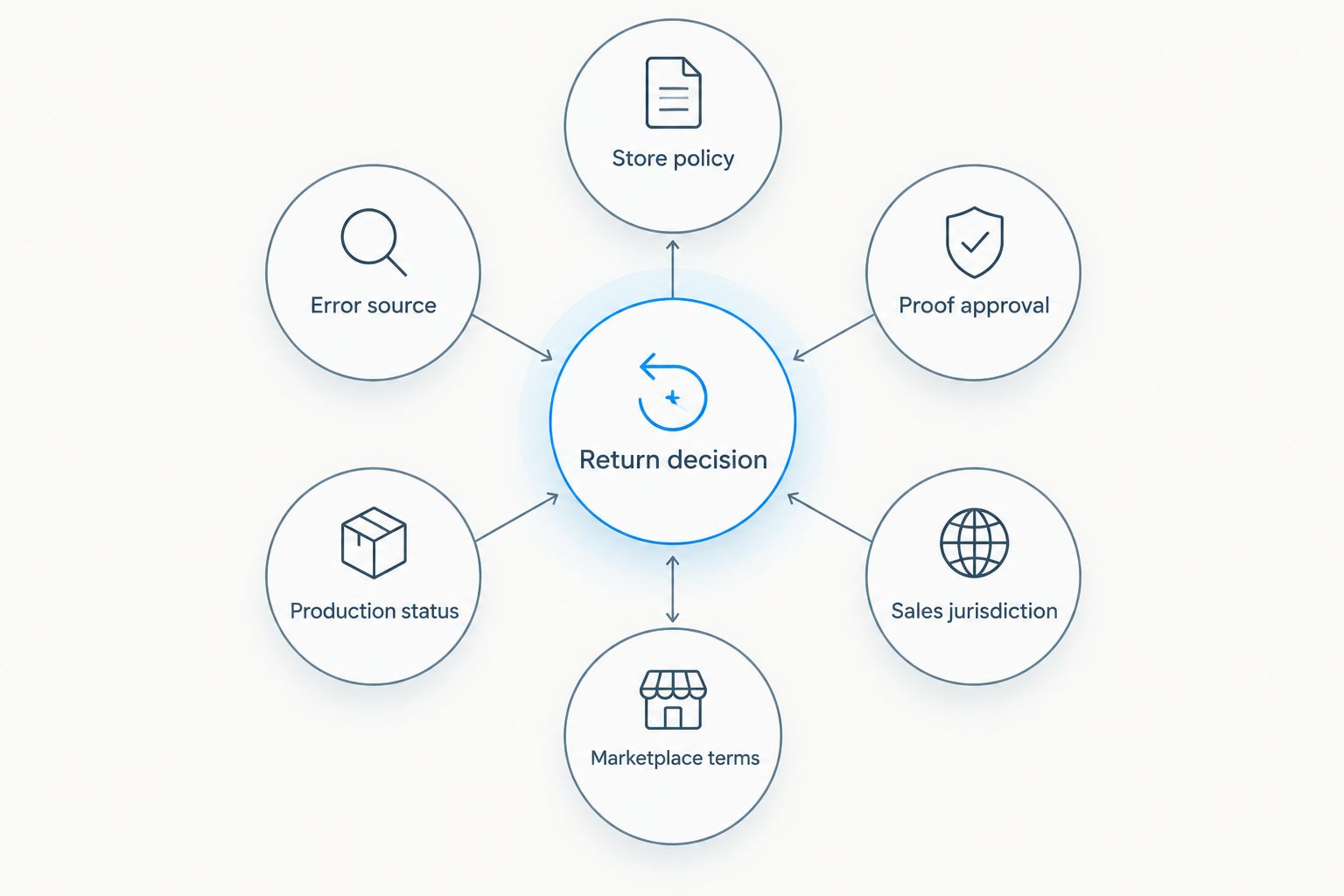
The approved order connects the customer’s request to the item that production delivered.
No single factor replaces the rest. A strict policy does not make a production error disappear, while a customer complaint does not prove that the merchant produced the wrong design.
How should a merchant review a return request?
Use the same sequence for every claim. Fast decisions come from consistent records, not long support threads.
- Identify the requested outcome. Ask whether the customer wants a correction, remake, replacement, exchange, store credit, refund, or cancellation.
- Capture the reported problem. Record whether the claim concerns damage, a defect, missing personalization, incorrect personalization, customer input, delivery, or preference.
- Compare the records. Check the order data, submitted text, uploaded files, selected options, approved preview, and production file.
- Confirm production status. For cancellations, establish whether materials were committed or personalization had started.
- Apply the correct policy branch. Separate seller errors and defects from buyer-remorse requests and customer-input mistakes.
- State the resolution clearly. Tell the customer what happens next and what information is still required.
Keep the original customer input unchanged. Editing an order record after a complaint removes the evidence needed to determine responsibility. Corrections should be stored as a new version with a clear approval trail.
A proof approval step before production makes this review faster. It gives support and production the same reference instead of relying on screenshots copied between inboxes.
What should a personalized return policy include?
A useful policy answers the customer’s decision questions before checkout. It does not hide every scenario behind final-sale language.
Include these points:
- Which products count as personalized, customized, made to order, or made to specification.
- When cancellation remains possible and what event closes that option.
- How customer-entered spelling, dates, initials, measurements, images, and other inputs are treated.
- Whether the customer must approve a preview or proof.
- How to report damage, defects, missing personalization, or a mismatch with the approved order.
- What evidence the customer should provide, such as packaging photos or images of the product.
- Which remedies the store provides for seller errors.
- Whether any discretionary option exists for customer-input mistakes.
- How marketplace purchases differ from purchases made directly through the storefront.
- Which regional terms apply to international orders.
Repeat the short version near the personalization fields and place the full policy in an accessible location before purchase. The wording on the product page, cart, checkout, confirmation email, and support response should agree in 2026.
Do not combine cancellation and return terms into one vague sentence. A customer can request cancellation before production, report damage after delivery, or ask to change an approved design while production is underway. Those events need separate rules.
How Bespo supports clearer return decisions
Bespo is a Shopify product personalization app for merchants selling embroidery, engraving, monograms, embossing, debossing, and print. It provides a live-preview customizer and outputs production-ready files without requiring developer involvement.
Bespo is best for Shopify merchants that need shoppers’ personalization choices connected to the files used for fulfillment. That record gives support teams a direct comparison when a customer says the finished item does not match the submitted design.
Bespo does not decide whether a return is legally required, inspect a physical defect, or write the merchant’s policy. The merchant still defines the terms, reviews the delivered item, and chooses the appropriate remedy. The strength is evidence and production consistency; the limitation is that software cannot resolve a policy or product-quality dispute by itself.
For a Bespo Shopify personalization workflow, connect the preview, approval, order details, and production file. That creates one reference path from storefront selection to fulfillment in 2026.
Create clearer personalized order records
Connect customer choices, live previews, and production-ready files in one Shopify workflow.
Can a customer return an item with their own typo?
A customer-entered typo does not automatically create a right to return a correctly produced item. The merchant should verify that the field was clear, the submitted value was saved accurately, and the delivered item matches it before applying the customer-error policy.
If the interface altered, truncated, or failed to save the text, responsibility shifts back to the merchant’s process. The order record and approved preview decide the issue more reliably than memory.
Is final sale enough to reject every personalized return?
No. Final sale usually addresses preference-based returns for correctly made goods; it does not automatically remove obligations relating to defects, damage, misdescription, or seller mistakes. The policy should state both the personalized-item restriction and the remedy process for genuine order failures.
A blanket rejection also creates an avoidable customer-service problem. Ask what went wrong, compare the evidence, and then apply the relevant policy branch.
Can a personalized order be canceled before it ships?
A personalized order can be canceled when the merchant’s policy permits cancellation at that production stage. Shipping status alone is not the correct test because engraving, printing, embroidery, or another irreversible process can begin before the parcel ships.
Use a production milestone instead. Tell customers whether cancellation closes at order approval, file preparation, material allocation, or the start of personalization.
FAQ
Can personalized products be returned in 2026?
Yes, personalized products can be returned in 2026 when they are defective, damaged, misdescribed, or different from the approved order. A correctly made item is subject to the merchant’s stated personalized-return policy and applicable law.
Can I return a personalized item if I changed my mind?
You can return it only if the seller’s policy accepts buyer-remorse returns for personalized goods. Many policies separate correctly made custom items from regular returnable inventory.
What if the seller misspelled my personalization?
A seller-created spelling error supports a correction, remake, replacement, or refund under the applicable policy and law. Compare the delivered item with the text shown in the order record or approved proof.
What if I entered the wrong name on a personalized order?
A merchant can apply its customer-input policy when the delivered item matches the name you submitted. Contact the seller quickly because cancellation or correction depends on whether production has started.
Can a final-sale personalized item be returned if it is damaged?
Yes, a final-sale label does not automatically eliminate remedies for damage or defects. Report the problem with photos of the item and packaging, then follow the seller’s claim process.
Do online purchases have a 3-day return right in the United States?
No, the FTC’s 3-business-day Cooling-Off Rule does not create a general return right for transactions completed entirely online. Store policy, state law, warranties, and the reason for the return still matter.
Does approving a proof prevent every return?
No, proof approval documents the chosen design but does not excuse damage, manufacturing defects, or production that differs from the proof. It primarily clarifies disputes about spelling, layout, images, and selected options.
Should personalized items use a separate return policy?
Yes, a separate section should explain cancellations, customer-input errors, proof approval, seller mistakes, damage, defects, and available remedies. This prevents final-sale wording from being applied to unrelated problems.
One last thing
The strongest return policy is not the strictest one. It is the one that lets a support agent compare the customer’s submitted design, the approved proof, the production file, and the delivered item without reconstructing the order from messages.
Set that evidence path before accepting personalized orders in 2026. The faster you identify who introduced the mismatch, the faster you can choose the correct response.