
The blog
Free Personalization Without Losing Margin? 2026 Verdict


Yes, you can offer free personalization without losing margin, but only if the production cost is already baked into your base price or your average order value climbs enough to cover it. Treat "free" as a pricing decision, not a discount, and the math holds; treat it as a freebie bolted onto your existing prices, and it eats your margin one order at a time.
TL;DR
- Free personalization only works when its cost is folded into the base price, not subtracted from margin.
- Engraving, embroidery and print carry different production costs — pricing them the same is the fastest way to lose money.
- Bespo merchants typically pair free personalization with a small AOV lift from bundles, upsells or minimum order rules.
- A flat personalization fee protects margin better than a free-for-everyone policy on complex techniques.
- Review your per-variant pricing before you advertise anything as free in 2026.
Why this matters
Merchants ask this question after watching a competitor advertise "free monogramming" or "free engraving included" and feeling pressure to match it. The move looks like a marketing freebie. It's actually a pricing exercise: someone still pays for the extra minutes of production time, the extra file handling, and the higher error rate that comes with customized goods.
Get the pricing structure wrong and "free" personalization becomes a line item that quietly drags gross margin down every month, even as unit sales climb. Get it right, and personalization becomes a driver of average order value instead of a cost center. The difference is entirely in how the fee is absorbed, not whether it's charged.
Can you offer free personalization without losing margin?
The answer depends on which of three pricing structures you use. Each one absorbs the personalization cost differently, and each suits a different kind of catalog.
Built into base price
- How it protects margin: Cost is spread across every unit, personalized or not
- Best for: Stores where most orders are already customized
Flat personalization fee
- How it protects margin: Customer pays a fixed add-on that covers the extra work
- Best for: Stores with a mix of standard and personalized SKUs
Tiered by technique
- How it protects margin: Complex techniques (engraving, embroidery) carry a higher built-in cost than simple text fields
- Best for: Stores selling across multiple personalization types
If you sell mostly personalized goods — monogrammed towels, engraved jewelry, custom pet tags — building the cost into the base price and advertising "free personalization" makes sense, because nearly every buyer triggers that cost anyway. If personalization is optional on a catalog that's mostly standard SKUs, a flat fee or a tiered structure protects margin better, because you're not subsidizing customization for buyers who never use it. Pricing personalized products by variant walks through how to set that variant-level pricing without guesswork.
Build the cost into the base price
This is the cleanest version of "free" personalization, and the one most likely to be true. Every unit's price already reflects the extra production step, so there's no separate line item at checkout and no per-order margin leak.
It works because the personalization cost is small and consistent — a name field, an initial, a short message — and the technique doesn't vary in complexity from order to order. It breaks down fast on techniques like embroidery or engraving, where production time swings depending on text length, placement, or material. Verdict: Buy this approach for simple, low-variance personalization; skip it for anything with unpredictable production time.
Charge a flat personalization fee that customers barely notice
A flat fee — set once and applied consistently — keeps the accounting simple and still lets you advertise the base product at a competitive price. Customers see personalization as an upgrade, not a hidden markup, which tends to convert better than surprise pricing at checkout.
The risk is setting the fee too low relative to your actual production cost. How much to charge for product personalization breaks down how to size that fee against fulfillment time instead of guessing a round number. Verdict: Buy this approach for mixed catalogs where personalization is optional.
Use tiered pricing by technique complexity
Engraving, embroidery, embossing, and print all carry different production costs, and pricing them identically is one of the most common margin leaks in personalization. A store that charges the same amount whether a customer picks a one-line engraving or a full embroidered design is subsidizing the more expensive technique with revenue from the cheaper one.
Tiered pricing solves this by matching the built-in or add-on cost to the actual technique, not a flat blanket rate. Verdict: Buy this approach the moment your catalog spans more than one personalization technique.
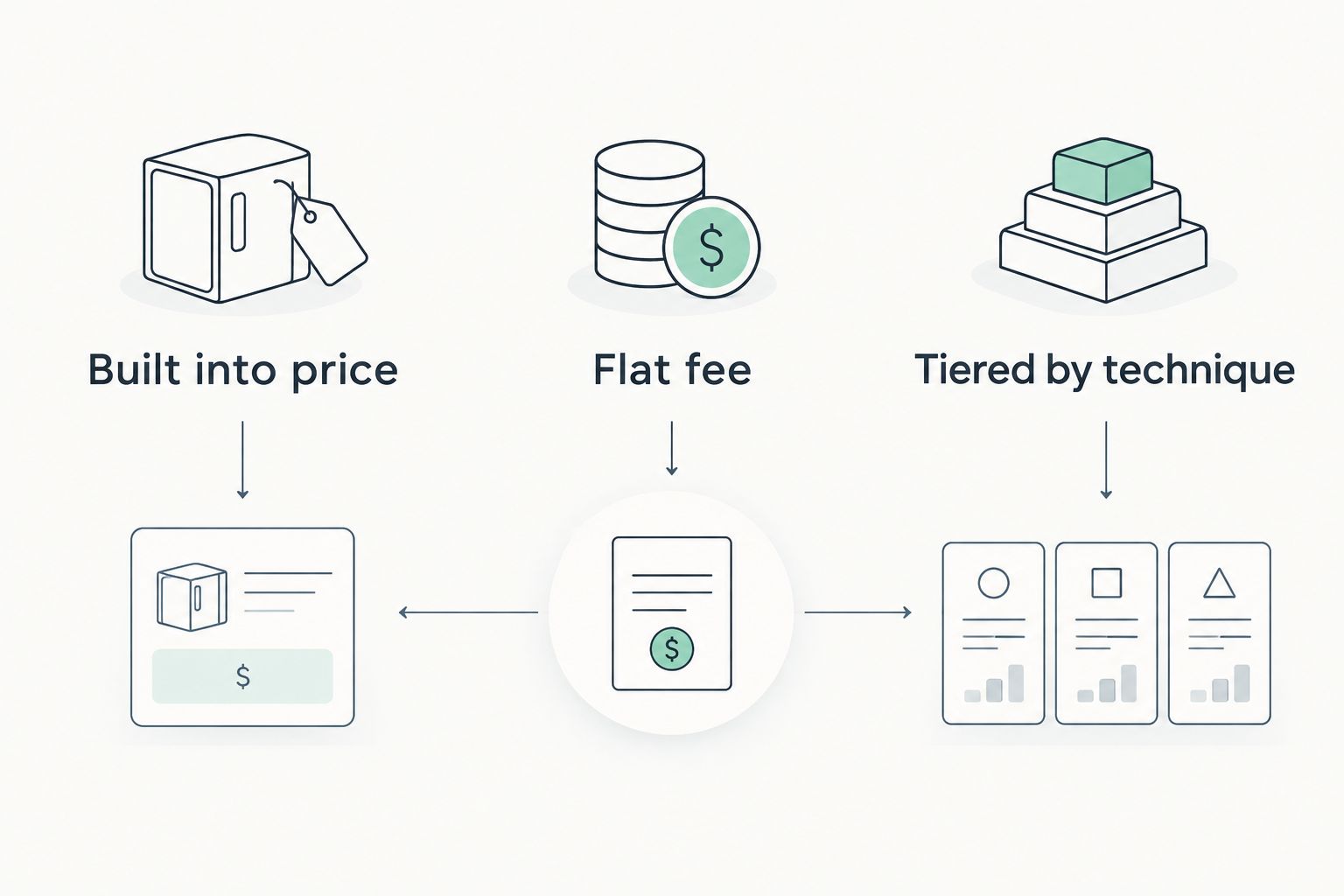
Each structure protects margin differently depending on how much of your catalog is personalized.
Why free personalization pricing varies
The right structure depends on a handful of factors specific to your catalog, not a universal rule:
- Technique mix — a store selling only text-field personalization can absorb cost more easily than one offering engraving, embossing, and embroidery side by side
- Order volume — high-volume stores can spread fixed personalization costs (proofing, file prep) across more units than low-volume stores
- Error and rework rate — personalized orders that require reprints or reproofs cost more per unit than standard SKUs, and that cost has to land somewhere
- Return policy — personalized goods are typically final sale, which changes the risk calculation compared to standard returnable inventory
- Fulfillment complexity — in-house production versus outsourced print-on-demand changes what "free" actually costs you per order
- Competitive pressure — matching a competitor's "free personalization" claim without checking your own production cost is how margin gets lost fastest
See your personalization pricing live
Preview real-time personalization pricing per variant before you launch it.
Does free personalization actually increase average order value?
Free personalization increases average order value when it's paired with a minimum order threshold, a bundle, or an upsell — not on its own. On its own, it removes a purchase barrier but doesn't guarantee a bigger basket; combined with a tiered discount on bulk orders, it tends to push order size up because customers add more units to hit the threshold.
Should you charge more for engraving than for print?
Engraving should generally carry a higher built-in or add-on cost than print, because it takes longer to produce and carries a higher error cost per unit if the file or setup is wrong. Custom engraving's added production cost has more detail on where that extra cost actually comes from.
Can tiered discounts offset the cost of free personalization on bulk orders?
Tiered discounts can offset the cost of free personalization on bulk orders by rewarding volume instead of giving away the personalization fee outright — the customer gets a break on price per unit as order size grows, while your per-unit production cost drops too because setup and proofing get spread across more units.
Offering it without checking production cost per technique is how stores end up quietly discounting their best-margin products in 2026. A live-preview customizer that shows the built-in or add-on price per variant before checkout — the kind Bespo runs on Shopify storefronts — removes the guesswork by pricing personalization at the SKU level instead of applying one blanket rule across the catalog.
FAQ
Can you offer free personalization without losing margin?
Yes, if the personalization cost is built into the base price or offset by a higher average order value — not subtracted from an existing margin. Stores that advertise free personalization without adjusting pricing structure typically see margin erosion within a few months.
Is free personalization better than charging a flat fee?
Free personalization built into the base price works best for catalogs that are mostly customized already; a flat fee works better for mixed catalogs where personalization is optional. Neither is universally better — it depends on what share of orders trigger the extra production cost.
How much does personalization actually cost to produce?
Production cost depends on the technique — engraving and embroidery take longer than a simple text field, and error rates differ by method. Checking the guide on custom engraving's production cost impact before setting a price is the fastest way to avoid underpricing.
Does personalization increase average order value?
Personalization can increase average order value when paired with bundles, minimum thresholds, or tiered bulk discounts. On its own, it mainly removes a purchase barrier rather than guaranteeing a bigger basket.
Should every product on my store offer free personalization?
No — free personalization makes sense on products where most buyers already personalize; on products where personalization is a minority choice, a flat or tiered fee protects margin better across the wider catalog.
What's the fastest way to check if free personalization is losing money?
Compare your per-variant production cost, including proofing and rework, against the built-in price for that SKU. If the cost exceeds the margin cushion in the base price, the personalization isn't actually free — it's subsidized by every other sale.
Can a Shopify app handle variant-level personalization pricing automatically?
Yes — a live-preview product customizer can price personalization per variant and technique without a developer rebuilding the theme, which is how most merchants avoid flat-rate pricing mistakes in 2026.
One last thing
The stores that lose the most margin on "free" personalization aren't the ones offering it — they're the ones offering it identically across every technique in the catalog. A store charging the same built-in cost for a one-line text engraving and a full embroidered design is losing money on the embroidery every single time. Fix the tier, not the freebie.