
The blog
How Long Does Custom Embroidery Take to Produce? Varies 2026


Custom embroidery has no universal production time in 2026; it takes the specific window your embroiderer confirms after reviewing the item, artwork, quantity and required completion date. That production window can exclude artwork preparation, proof approval and shipping, so ask for the date the finished order will leave the facility rather than relying on one turnaround figure.
TL;DR
- How long does custom embroidery take to produce? Use the fulfiller’s confirmed production window for the specific job.
- Artwork preparation, proof approval, stitching, quality control and shipping are separate stages in 2026.
- Bespo suits Shopify merchants needing live embroidery personalisation and production-ready order files.
- A rush label means little unless the supplier confirms the production-complete date and carrier handoff date.
Why this matters
An embroidery turnaround can refer to several different periods. One supplier starts the clock after payment. Another starts after artwork approval. A third only quotes machine time. If those definitions are not visible on the product page, two people can read the same estimate and expect different delivery dates.
Shopify merchants should show the distinction before checkout. A clear estimated production time tells the buyer when an item is expected to be made, while a separate shipping estimate covers carrier transit. That distinction matters in 2026 because personalised orders cannot move into production until the seller has usable order details.
How long does custom embroidery take to produce?
The reliable answer is the production window confirmed for the specific order. Custom embroidery passes through several stages, and the quoted turnaround only means something when you know which stages it includes.
Artwork review
- What starts it: Seller receives the design
- What completes it: Artwork is accepted for preparation
- Main delay to check: Missing or unsuitable artwork
File preparation
- What starts it: Artwork is approved
- What completes it: A usable production file is ready
- Main delay to check: Design changes or unclear details
Proof approval
- What starts it: A proof is issued
- What completes it: The buyer or seller approves it
- Main delay to check: Slow feedback or new revisions
Embroidery production
- What starts it: The job enters the queue
- What completes it: Stitching and finishing are complete
- Main delay to check: Queue capacity or order complexity
Quality control
- What starts it: Production finishes
- What completes it: The order passes inspection
- Main delay to check: Placement, thread or finish issues
Shipping
- What starts it: The carrier receives the parcel
- What completes it: The customer receives it
- Main delay to check: Service level and destination
A production quote should identify its start event and end event. If the quote starts after proof approval, every day spent reviewing the proof sits outside the production window. If the quote ends when stitching finishes, quality control and packing may still follow.
The most useful question is not simply how long the embroidery takes. Ask: On what date will this approved order be ready for carrier collection? That wording forces the supplier to include queue time, stitching, finishing, inspection and packing in one operational answer.
A 2026 product page should also state whether the displayed estimate changes after a customer requests an artwork revision. A new name, thread colour, placement or logo version can return the order to an earlier stage. The original estimate no longer describes the revised job unless the supplier confirms that it still applies.
Why custom embroidery production time varies
No single timeline fits every embroidered product. These factors determine which production window a supplier can commit to:
- Artwork readiness. A clear design that meets the supplier’s file requirements can proceed to preparation. Missing details, conflicting colours or unsuitable artwork create another review cycle before stitching can begin.
- Personalisation type. A fixed logo repeated across an order creates a different workflow from individually named products. Unique customer inputs require accurate order data for every personalised item.
- Design complexity. Thread changes, fine details, small lettering and difficult placements affect how a design is prepared and run. Ask the embroiderer to assess the actual design rather than estimating from the garment alone.
- Product construction. A flat item and a structured item do not follow identical handling and placement processes. The supplier must confirm that the chosen product and location suit the intended embroidery.
- Order quantity. Quantity affects production scheduling and inspection. A larger order can be efficient once running, but it still needs enough queue capacity and time for every item to be checked.
- Approval speed. Production cannot follow the approved version until the responsible person has accepted it. An unclear approval owner creates avoidable waiting between file preparation and the machine queue.
None of these factors produces a universal number. They produce a job-specific commitment. That is why an estimate copied from another supplier, product or previous order is not a reliable promise for a new 2026 order.
For Shopify sellers, the order form needs to capture the same details the production team expects. A monogram order should record the exact characters, character order, style choice, colour and placement offered by the merchant. A logo order needs the correct upload and any permitted choices. The monogramming setup process should match the production workflow rather than collecting free-form notes that someone must interpret later.
How to estimate an embroidery completion date
Use a six-step estimate instead of adding an unsupported turnaround number to every product.
Define the order cut-off. Decide when an order becomes ready for review. Payment alone may not be enough if the artwork, product choice or personalisation details are incomplete.
Confirm the artwork state. Separate artwork received from artwork approved. The first means the file arrived. The second means it contains enough information to prepare the production file.
Name the approval owner. Assign one person to approve the proof. For a direct-to-consumer order, that may be the shopper or the merchant. For a corporate order, it may be the buyer responsible for the complete batch.
Request the production-complete date. Ask the fulfiller when stitching, finishing, quality control and packing will be complete. Do not substitute a generic website estimate for confirmation on the actual job.
Add the carrier handoff date. Production completion and dispatch are not automatically the same event. Record when the packed order is scheduled to enter the carrier network.
Communicate changes immediately. If an artwork revision or product substitution changes the schedule, update the customer-facing estimate. Do not leave the original date visible after the assumptions behind it have changed.
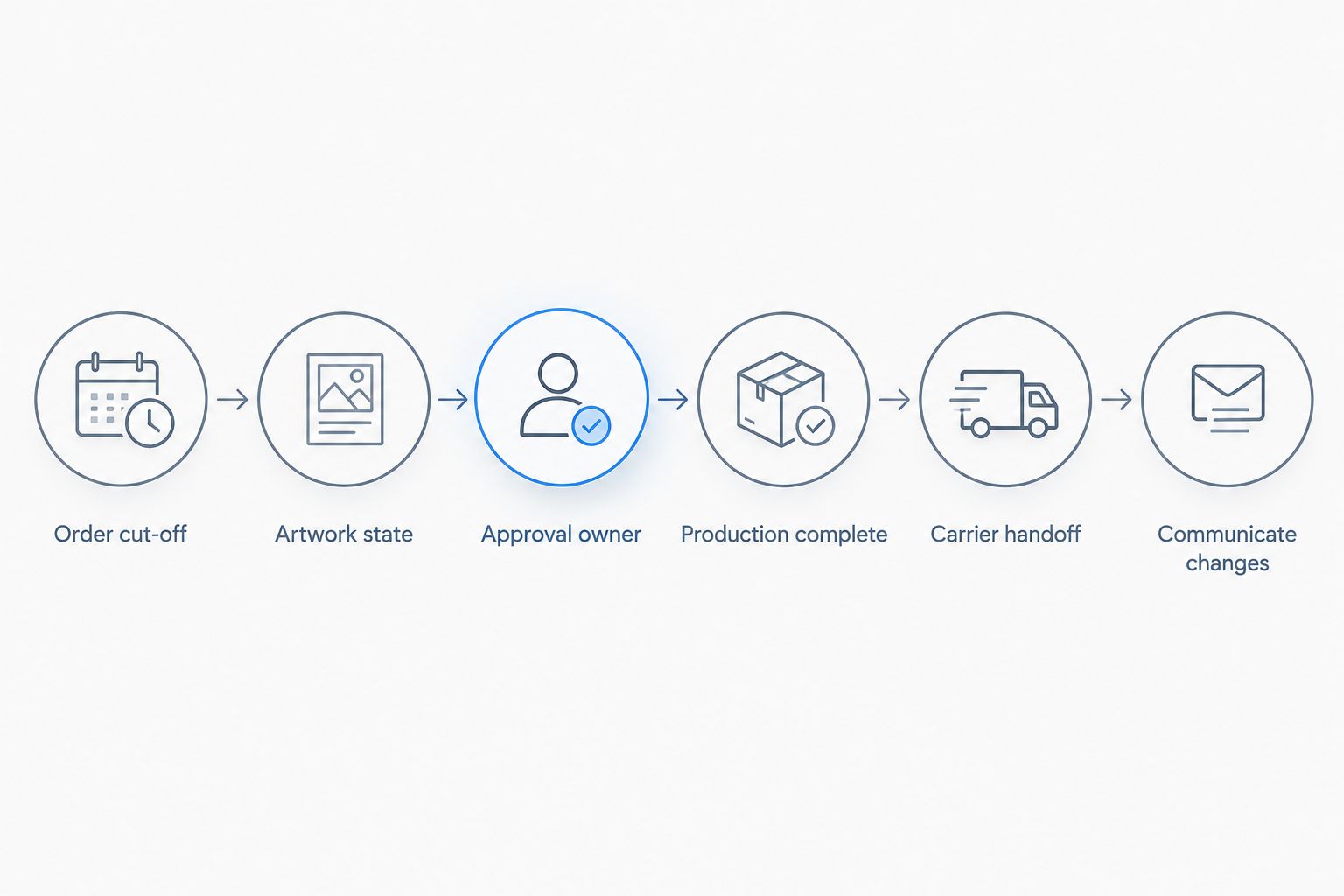
A reliable estimate tracks the order from complete inputs through carrier handoff.
This six-step method works because every date has an owner and a clear trigger. It also exposes waiting time. If the proof is ready but nobody is assigned to approve it, the order has not suffered a production delay; it has suffered an approval delay.
For 2026 planning, record the promised date alongside the current stage. A customer should be able to see whether an order is awaiting artwork, awaiting approval, in production, under inspection or dispatched. Those labels are more useful than a vague status that says the order is processing.
Does digitising count as embroidery production time?
It depends on how the supplier defines production. Some quotes begin only after the embroidery file and proof are approved, so artwork preparation sits outside the stated window. Ask for both the file-ready date and the production-complete date to remove that ambiguity.
Digitising should not be treated as an invisible task. It translates artwork into instructions suitable for embroidery equipment, and the result must account for the intended item and placement. A supplier needs the actual design before confirming whether preparation is straightforward or requires revisions.
Does shipping count in an embroidery turnaround quote?
Production and shipping are separate stages unless the supplier explicitly combines them. A production-complete date tells you when the order is ready to leave; a delivery estimate covers the period after carrier collection.
This distinction should appear in customer messaging. Do not present a production estimate as an arrival promise. In 2026, show the expected dispatch stage separately from carrier transit so the buyer knows which business controls each part.
Can a product personalisation app shorten production time?
A product personalisation app does not make an embroidery machine run faster or control a fulfiller’s queue. It can collect structured choices, show the shopper a live preview and output order files for fulfilment, which gives the production team clearer inputs at the start of the workflow.
Bespo is best for Shopify merchants that need real-time embroidery personalisation and production-ready files; it is not an embroidery fulfiller. That distinction matters. Software can organise the order data, but the embroiderer still controls file acceptance, scheduling, stitching, inspection and dispatch.
Where Bespo fits
Bespo is a Shopify product personalisation app for merchants offering embroidery, engraving, monograms, embossing, debossing and print. It gives shoppers a live-preview customiser and outputs production-ready files for fulfilment. The app serves businesses ranging from one-person Shopify stores to high-volume DTC brands and corporate gifting operations.
Shopper personalisation inputs
- The embroidery fulfiller handles: Artwork and file acceptance
Real-time product preview
- The embroidery fulfiller handles: Machine scheduling
Production-ready order files
- The embroidery fulfiller handles: Stitching and finishing
Storefront personalisation workflow
- The embroidery fulfiller handles: Inspection, packing and dispatch
The main benefit is clear separation of responsibilities. Bespo can structure what the shopper selects and what the production team receives. Its limitation is equally clear: it does not operate the embroidery equipment, reserve queue capacity or deliver the finished product.
A 5-minute setup can help a merchant launch the storefront workflow without a developer, but it does not create a 5-minute embroidery turnaround. Keep the software setup promise separate from the fulfiller’s production commitment.
Set up embroidery personalisation
Launch Bespo in 5 minutes with no developer needed.
FAQ
What is included in custom embroidery production time?
Custom embroidery production time includes only the stages named by the supplier. Confirm whether artwork preparation, proof approval, quality control and packing are inside or outside the quoted window.
When does the embroidery turnaround clock start?
The embroidery turnaround clock starts at the event defined by the supplier, often after the order details and artwork are approved. Ask for the exact start event before promising a customer-facing date.
Can custom embroidery be completed by a fixed event date?
Custom embroidery can meet a fixed event date only when the embroiderer confirms the approved order’s production-complete and dispatch dates. Leave artwork review, approval and carrier transit visible in the plan.
Why is my custom embroidery order delayed?
A custom embroidery order is delayed when a required stage finishes later than planned. Check artwork acceptance, proof approval, production scheduling, inspection and carrier handoff to identify the blocked stage.
Does a complex embroidery design take longer?
A complex embroidery design requires the supplier to assess preparation and machine requirements before confirming a timeline. Fine details, thread changes and difficult placements should be reviewed on the actual item.
How should Shopify stores show embroidery turnaround in 2026?
Shopify stores should show production and shipping as separate estimates in 2026. They should also explain when the production estimate starts and what happens after a customer requests a revision.
Is live preview the same as an embroidery proof?
No, a storefront live preview is not automatically the supplier’s production proof. The fulfiller must confirm which file or approval controls the final stitched result.
One last thing
Track five dates for every custom embroidery order: details received, artwork accepted, proof approved, production complete and carrier handoff. That five-date record shows exactly where time was spent without blaming production for a delay that occurred before or after stitching.
For a 2026 Shopify workflow, make those stages consistent across the product page, order record and fulfilment handoff. Clear stage names beat one unsupported turnaround promise.