
The blog
How Much Can Personalization Add to AOV in 2026?


Personalization doesn't add a fixed percentage to average order value — it adds AOV through three specific revenue levers, and how much you capture depends entirely on how you price and place them. The catch most merchants miss: personalization only lifts AOV when it's charged as a line item. Give it away free and you might lift conversion, but the cart total stays flat.
TL;DR
- Personalization raises average order value through three levers: higher SKU pricing, add-on fees, and gift bundling.
- There's no universal percentage for how much personalization adds to average order value — it depends on category and pricing structure.
- Free personalization can lift conversion but does nothing for AOV unless it's priced separately.
- Bespo merchants price personalization as a checkout line item specifically to capture this AOV gain in 2026.
Why this matters
Most merchants ask "does personalization boost AOV" as if the answer is a single number they can plug into a forecast. It isn't. Personalization is a mechanism, not a metric — it changes what customers are willing to pay for, not what they'll pay on average across every store.
The merchants seeing the biggest AOV impact in 2026 aren't the ones with the fanciest customizer. They're the ones who priced the feature deliberately instead of bolting it on as a free perk. Bespo exists to make that pricing decision easy to execute — a live-preview customizer that lets shoppers see their personalized product before checkout, with the pricing logic built into the product setup rather than handled by a developer.
How much can personalization add to average order value?
The honest answer is a range of mechanisms, not a range of numbers. Here's where the lift actually comes from:
Higher price point for the customized SKU
- How it lifts AOV: Shoppers pay more for the personalized version instead of the stock item
- Best for: Stores where personalization replaces the base product entirely
Add-on personalization fee
- How it lifts AOV: A separate line-item charge (engraving, monogram, embossing) stacks on top of the existing cart total
- Best for: Stores selling personalization as an optional upgrade
Gift bundling and messaging
- How it lifts AOV: Personalization pushes buyers into gift-mode purchases, which pull in wrapping, cards, and multi-item bundles
- Best for: Gifting-heavy categories like jewelry and corporate gifts
Reduced return-driven discounting
- How it lifts AOV: Personalized items are rarely returned, so realized revenue per order stays closer to the original cart total
- Best for: Categories with high return rates on standard SKUs
The most reliable AOV gain comes from treating personalization as its own priced line item, not folding it silently into the base price. If you're unsure what to charge, how much should you charge customers for product personalization walks through the pricing logic merchants actually use.
Where the AOV gain actually comes from
Take a $40 product with a $6 monogramming fee attached at checkout. That single add-on is a 15% lift on that one order — not an industry average, just arithmetic on that cart. Multiply that across every personalized order in 2026 and the AOV shift becomes visible in your reports within a few weeks, not months.
The mechanism only works if the fee is visible and separate. Bundle the $6 into the base price and shoppers never register they paid a premium for personalization — you lose the pricing signal and the AOV data point. How to price personalized products by variant on Shopify covers how to structure this at the variant level so the fee shows up cleanly in reporting.
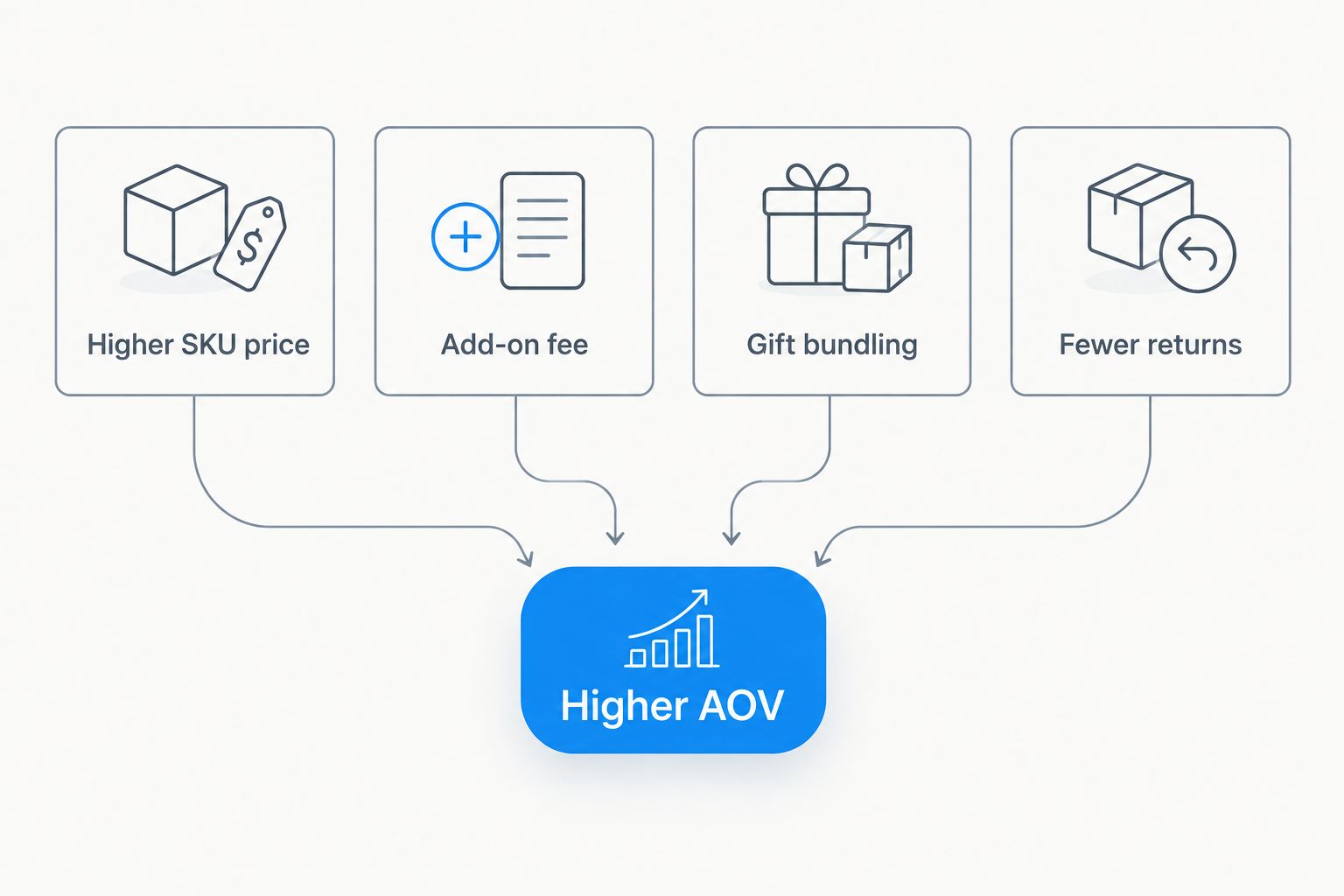
Each lever moves AOV differently — pricing determines which one you actually capture.
Add-on fees vs. included pricing
Merchants who fold personalization into the base price tend to see a conversion bump but a flat AOV, because nothing in the cart total changed relative to a non-personalized version. Merchants who charge separately see the opposite: a smaller conversion bump, but a cart total that's measurably higher on every personalized order.
Neither approach is wrong — they solve different problems. If your goal in 2026 is unit volume, bundle the cost in. If your goal is average order value specifically, charge for it as a distinct line.
Why the AOV lift varies store to store
The size of the gain depends on factors that are specific to your catalog, not the personalization feature itself:
- Base product price — a $6 fee on a $15 item moves AOV more, proportionally, than the same fee on a $150 item.
- Category — gifting categories (jewelry, corporate gifts, home decor) see personalization pull in bundled items; utility categories (workwear, tools) don't.
- Whether personalization is optional or default — an optional upgrade shows up as a clean AOV delta; a default feature gets absorbed into the base price and disappears from reporting.
- Where the fee is shown — a fee disclosed on the product page converts differently than one revealed only at checkout, and that affects both conversion and cart value.
- Return rate on the standard SKU — categories with high baseline returns benefit more from personalization's lower return rate, because realized AOV (after refunds) improves even if listed AOV doesn't.
- Production friction — if personalization adds meaningful lead time, some shoppers switch to the standard SKU instead of paying the premium, capping the lift.
Price personalization the right way
Set up a live-preview customizer with pricing built into the product, not the checkout.
Related questions people ask
Does personalization increase returns along with AOV?
Personalized items are typically returned less often than standard SKUs, since a name-engraved or monogrammed product can't be resold as new stock. That lower return rate is part of why personalization protects realized AOV even when listed AOV looks similar to non-personalized orders.
Should personalization be free or paid to boost AOV?
Paid personalization is what actually moves average order value — free personalization only affects conversion rate, since it doesn't change the cart total. If you're weighing the trade-off, best Shopify tools to increase average order value compares personalization against other AOV levers like bundling and upsells.
Does personalization work for low-price products?
Yes, and often better proportionally — a flat fee on a lower-priced item represents a bigger percentage lift than the same fee on a high-ticket product. A percentage-based fee instead of a flat fee keeps the math consistent across a wide price range in a single catalog.
FAQ
How much can personalization add to average order value?
Personalization adds to average order value through pricing mechanics rather than a fixed industry percentage — a separate add-on fee, a higher SKU price for the customized version, or gift bundling all move the cart total upward. The size of the gain depends on your base price and how visibly the fee is charged.
Is personalization worth it for average order value alone?
Personalization is worth pursuing for AOV specifically when the fee is charged as its own line item rather than absorbed into the base price. Bundled-in personalization tends to lift conversion instead, without moving the cart total.
What's the best way to price a personalization add-on?
A percentage-based fee scales consistently across a catalog with varied price points, while a flat fee is simpler to communicate on a single-price product line. Either way, the fee needs to appear as a visible line item for it to register as an AOV gain.
Does free personalization hurt average order value?
Free personalization doesn't hurt AOV, but it doesn't help it either — it typically lifts conversion rate instead, since the cart total is unchanged from a standard product purchase.
Do personalized products get returned less often?
Personalized products are generally returned less than standard SKUs because a name-engraved or monogrammed item has limited resale value for the merchant, which discourages impulse returns.
Which categories see the biggest AOV lift from personalization?
Gifting-heavy categories like jewelry, corporate gifts, and home decor tend to see the biggest lift, because personalization pulls buyers toward bundled purchases like gift wrap and multi-item sets rather than a single item.
Can a Shopify app add personalization without a developer?
Yes — apps built for this let merchants add a live-preview customizer and configure pricing for personalization directly in the product setup, without a developer build.
One last thing
Most merchants track personalization as a feature, not a pricing line — and that's the reporting gap that hides the AOV gain. Run a two-week test in 2026: put a visible, separate fee on your highest-volume personalized SKU and check the cart total against the non-personalized version of the same product. That single comparison tells you more about your actual AOV lift than any industry benchmark will.