
The blog
Print on Demand Without Paid Ads: Profitable in 2026?


Yes, print on demand can be profitable without paid ads in 2026. You need sales from channels you can sustain, and the revenue left after production, fulfilment, payment fees and other costs must exceed what you spend running the store. Organic traffic is not free: content, outreach and customer service still take time or money.
TL;DR
- Print on demand can be profitable without paid ads in 2026 if organic sales cover every cost, not just printing.
- Search, email, social content and partnerships offer different routes to sales; each takes work.
- Bespo is best for Shopify merchants adding product personalisation, not for generating traffic or printing orders.
- Check profit per order and store-wide costs before deciding whether an organic channel works.
Is print on demand profitable without running paid ads?
Yes, if the orders you earn without ads produce enough contribution to cover your fixed costs and the work required to earn those orders. The absence of an ad bill does not, by itself, make a store profitable in 2026. You still have to pay for each order and maintain the channels that bring shoppers in.
Work through the answer in this order:
- Calculate revenue per order. Use the amount the customer pays, including any shipping charge you collect. Keep taxes collected on behalf of an authority out of your revenue calculation.
- Subtract order-level costs. Include the product, printing, fulfilment, shipping you pay, payment processing and any per-order app charges. Account for refunds, replacements and other losses using your actual records.
- Find your contribution per order. The remainder is what that sale contributes toward store-wide expenses and profit. A positive figure is necessary, but it does not prove the business is profitable.
- Subtract store-wide expenses. Include your platform, apps, content production, tools and any paid help. Count the time you spend creating designs, publishing content and supporting customers when judging whether the model works for you.
- Check the source of the orders. Separate search, social, email and partner-driven sales where your tracking allows it. Keep the channels that bring in orders with enough contribution to justify the work.
Your print-on-demand provider's unit charge is only part of the calculation. The guide to print-on-demand cost per unit covers the cost question in more detail; use your own supplier invoices for the final decision.
Why this matters
An ad-free store avoids paid acquisition charges, but it must earn attention another way. That usually means publishing pages shoppers can find, building an audience, reaching existing customers or working with relevant partners. None of those activities guarantees an order.
Profitability also depends on what happens after the sale. A product can look attractive against its print charge and still leave too little after shipping, fees and replacement orders. If you only track sales and supplier costs, you can keep promoting an offer that does not pay for the store supporting it.
In 2026, treat an organic channel as a business process, not a traffic shortcut. Record what you publish, what visits and orders it brings in, and what it takes to maintain. Then compare channels using the same profit calculation.
Which ad-free channel fits your store?
There is no single best source of unpaid traffic. Choose a channel based on where your intended buyer already looks and whether you can keep producing what that channel needs. The trade-offs matter as much as the opportunity.
Search
- Best for: Products people already describe in searches
- What you do: Build specific product and helpful content pages
- Main advantage: A relevant page can meet a buyer's stated need
- Main drawback: Visibility takes work and is not guaranteed
Organic social
- Best for: Products that are easy to show in use
- What you do: Publish designs, demonstrations and customer-approved examples
- Main advantage: Shoppers can understand the product quickly
- Main drawback: Posts need ongoing production and distribution
- Best for: A store with permission to contact past shoppers or subscribers
- What you do: Send relevant product and occasion-based messages
- Main advantage: You can reach an audience you have already built
- Main drawback: It cannot create an audience you do not have
Partnerships
- Best for: Products suited to a defined group or occasion
- What you do: Work with relevant creators, organisations or communities
- Main advantage: A partner can introduce the product to its audience
- Main drawback: Outreach and coordination take time
Best for an ad-free start: pick one channel you can maintain, then judge it by profitable orders rather than views. A narrow product page aimed at a clear search need is more useful than a broad page with no distinct buyer. An email campaign is useful only if you have people who agreed to receive it. A partnership needs a relevant audience, not simply a large one.
Do not treat unpaid as a synonym for effortless. If social content takes more work than the resulting contribution supports, that channel is not serving the business. The same test applies to search content, email and outreach. In 2026, your own order and workload records decide which route earns its place.
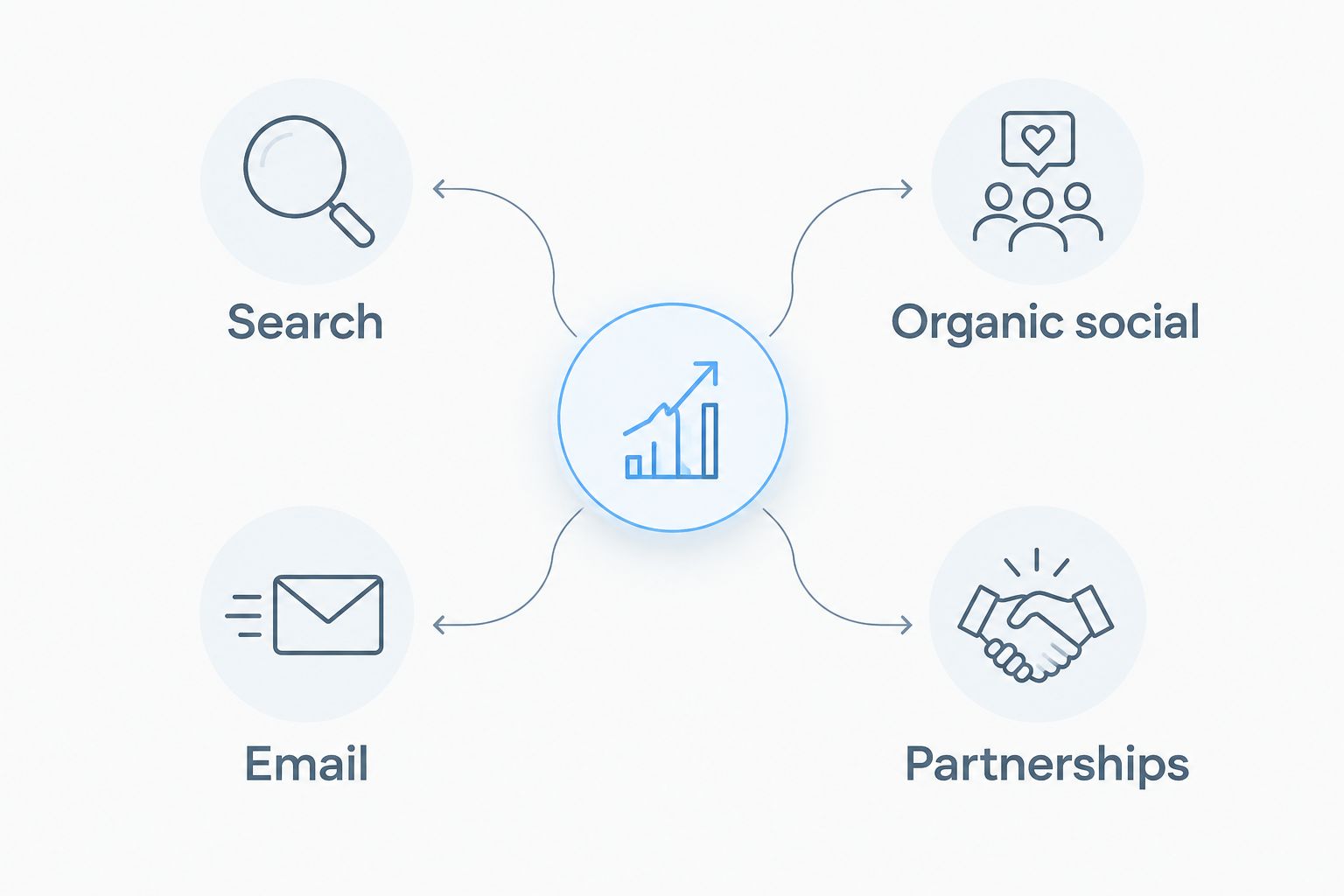
Choose a channel you can maintain, then judge it by profitable orders.
Why print-on-demand profit varies
The same sales channel can support one product and fail another. Check the drivers you control before deciding that organic traffic is the problem:
- Product and print costs. Different products and production choices leave different amounts from a sale. Check the actual charge for the item you intend to sell.
- Shipping paid versus shipping collected. A shipping charge shown at checkout is revenue, but the fulfilment and delivery bill is still an expense. Track both sides.
- Returns and replacements. Damaged, incorrect or disputed orders can change the result after the original sale. Use your own order history rather than assuming every order stays profitable.
- Product positioning. A page aimed at a defined recipient, use or design preference gives you a clearer subject for search content and outreach. Broad claims make it harder to explain why someone should choose the product.
- Channel workload. Writing pages, making posts and managing partners all consume resources. Count that work when comparing unpaid channels with paid acquisition.
- Repeat orders. An existing customer can buy again without discovering the store from scratch. Track repeat purchases separately; do not assume they will happen.
These factors interact. A product with healthy contribution per order can still fail to cover the work of attracting buyers. A channel that sends fewer visits can be more useful if those visitors place orders that leave sufficient contribution. Use profit, not traffic volume, as the deciding measure.
Can personalisation improve the economics?
Personalisation gives you a more specific offer to describe: a shopper chooses details for the item instead of selecting only a standard design. That distinction can support product pages and organic content aimed at a particular recipient or occasion. It does not guarantee demand, a higher selling price or a better margin. Check the extra production work and any app cost against the contribution your orders actually leave.
Bespo is best for Shopify merchants who want to add live-preview product personalisation without developer involvement; it is not a source of traffic or a print-on-demand fulfilment provider. Bespo supports options including print, embroidery, engraving and monograms, and provides production-ready files for fulfilment. The benefit is a clearer path from the shopper's choices to the production file. The limitation is just as important: Bespo does not replace the work of attracting buyers or checking whether each product makes money.
If you sell print-on-demand items through Shopify, decide what the customer can change before adding fields to a page. Name, wording and uploaded artwork create different production requirements. Offer only choices your fulfilment process can carry through correctly, then check the completed order and file before relying on that setup for sales.
How do you test the idea without buying traffic?
A useful test checks both demand and contribution. Do not judge it solely by whether people like a design. A store needs buyers who complete an order and leave enough revenue behind to support the work.
- Choose a defined buyer and use. Start with a product you can explain in plain language: who it is for, what they can choose and why they would buy it. Avoid treating a generic product category as a complete audience.
- Confirm the fulfilment path. Check what your provider needs to print the design and complete the order. If you offer personalisation, check how the shopper's choices reach production.
- Build a page that answers buying questions. Show the product, the available choices and the information a customer needs to place an accurate order. Do not promise production or delivery terms you have not confirmed.
- Publish for one channel. Create search-focused content, make social demonstrations, contact relevant partners or reach an email audience you already have. Choose a route you can sustain rather than opening every channel at once.
- Review completed orders and effort. Calculate contribution from actual orders. Add the recurring store costs and the work behind the channel before calling the test profitable.
This sequence keeps the decision grounded in orders. If a page receives attention but no purchases, improve the offer or the page before producing more content of the same kind. If orders arrive but leave too little contribution, revisit the product and its costs. If both work, keep tracking them as volume changes.
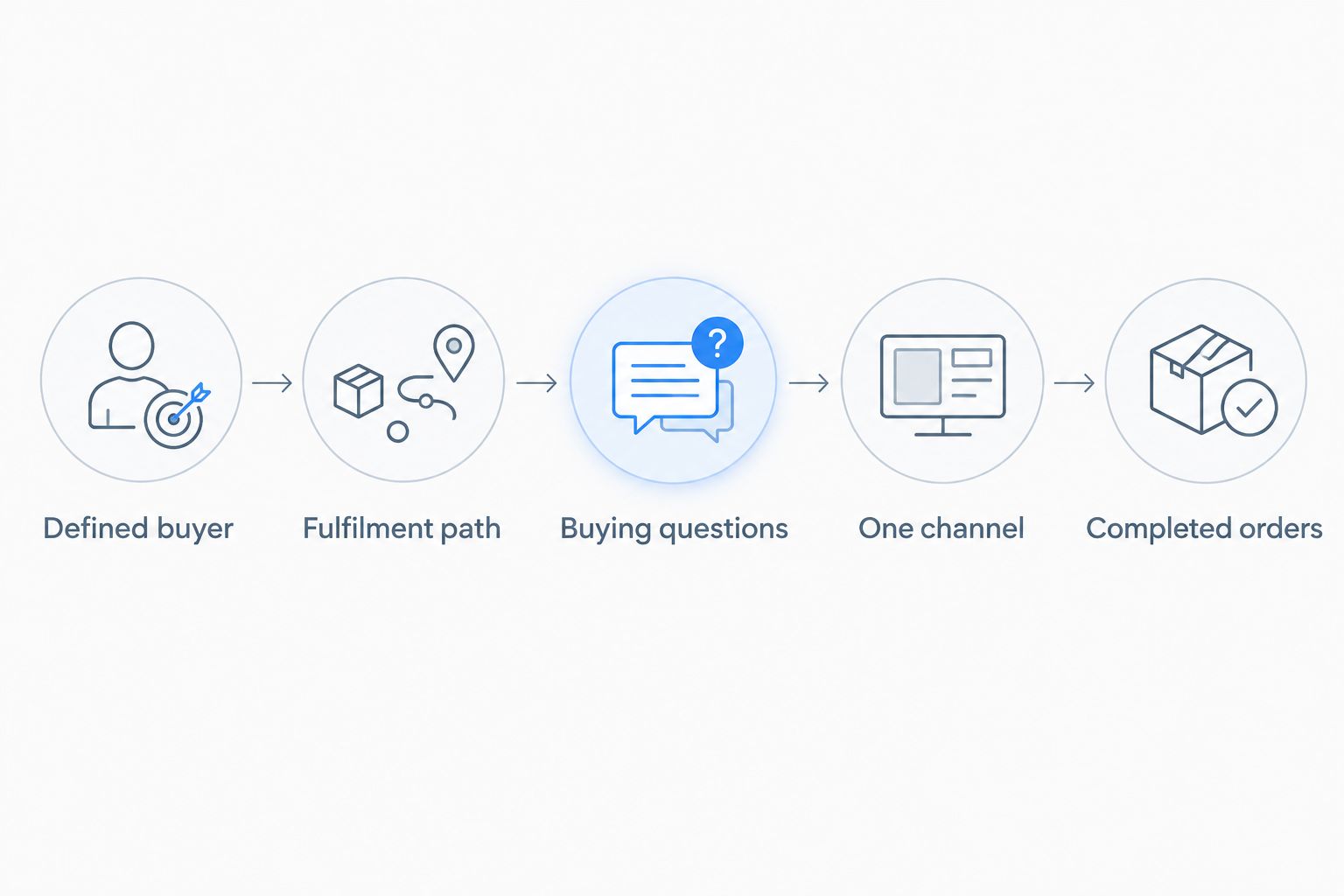
A useful test follows the product through to completed orders and the work required to earn them.
What should you measure before calling it profitable?
Keep a record that connects orders to costs and acquisition work. You do not need an elaborate report to spot the gap between sales and profit. You do need to use the same definitions each time you review the store.
- Revenue and completed orders: Count what customers paid for orders that remain valid after refunds and adjustments.
- Contribution per order: Subtract the costs caused by fulfilling and processing each order. This shows what remains to support the rest of the business.
- Store-wide costs: Record platform charges, apps, tools and paid help separately from order-level costs so you do not count them twice.
- Channel and content effort: Note which activities produced identifiable visits and orders, alongside the time or spending required to maintain them.
- Order problems: Track replacements, incorrect personalisation details and other issues that create additional work or expense.
Where attribution is unclear, do not assign every order to the content you most recently published. Ask customers how they found you where practical, and use available store and channel records together. The aim is a sound decision about where to spend your effort, not a flattering traffic report.
In 2026, the clearest signal is sustained store-level profit after the costs of earning and fulfilling orders. A profitable individual sale is a good start. It is not the finish line.
FAQ
Is print on demand profitable without paid ads in 2026?
Yes, print on demand can be profitable without paid ads in 2026 when sales earned through unpaid channels cover fulfilment, fees, store costs and acquisition work. Calculate profit from completed orders rather than assuming that no ad spend means no acquisition cost.
What's the best free traffic source for a print-on-demand store?
There is no single best source for every store. Search fits products buyers actively look for; organic social fits products you can show clearly, while email needs an existing audience.
Can you start print on demand with organic search alone?
Yes, you can use organic search as your only acquisition channel, but profitability depends on whether it brings orders that cover your costs and content work. Search visibility and sales are not guaranteed.
Does personalisation make print on demand more profitable?
Personalisation does not automatically make print on demand more profitable. Compare any change in order contribution with the added production work and app costs using your own completed orders.
Is a profitable print-on-demand order the same as a profitable store?
No. An order with positive contribution still has to help cover platform charges, tools, content work and other store-wide costs before the store earns a profit.
Can Bespo bring organic traffic to my Shopify store?
No. Bespo is a Shopify product personalisation app, not a traffic source. You still need a way for shoppers to find your products and a process for checking whether their orders are profitable.
How do I know whether an ad-free print-on-demand channel works?
Track completed orders, their contribution and the work required to earn them. Keep a channel when those orders help cover store-wide costs; do not judge it by views alone.
One last thing
The first problem to solve is not how to avoid an ad bill. It is whether your chosen product leaves enough from each completed order to support the store and the work of finding customers. Make that calculation before expanding the catalogue or publishing more content. In 2026, an ad-free store is profitable only when its full economics work.